Fiat 500 or Méhari: which classic should you drive in Rome?
The difference no amount of money can close
Before the gearbox, before the seats, before anything else: a vintage 500 cannot drive into central Rome.
A petrol Fiat 500 is stopped twice over. By the Fascia Verde, the low-emission zone that keeps older vehicles out of a very large part of the city. And by the historic centre ZTL, where what counts is access authorisation, and it has none.
Ours is an electric quadricycle, type approval L7e. In Rome's own regulations quadricycles are among the vehicles admitted into the Historic Centre restricted zone. It goes where the other one cannot — and this is not about price: there is no permit a petrol 500 can buy to get in.
And there is a sequel: being electric, ours parks free in the blue-line bays, which in the centre are just about the only place you can actually stop.
If your Roman drive stops at the edge of the centre, the 500 is a fine choice. If you want to cross it, the choice has already been made for you.
Then comes the gearbox, which is the second thing that matters
Both are icons and both are beautiful. But if you are the one driving, with nobody beside you to rescue the situation, the second difference is not taste. It is the gearbox.
A vintage Fiat 500 is a manual. Not only manual: on the early cars the gearbox is unsynchronised, which means double-declutching on the way down is a skill you learn, not one you improvise. In Roman traffic. On the climb into the hills. With a clutch that does not forgive.
An electric Méhari has no gearbox at all. No clutch, no gears, no noise. If you have ever driven an automatic, you already know how to drive it.
Put bluntly: roughly half of North American and Australian visitors cannot drive a manual. For them a vintage 500 is not a difficult choice. It is an impossible one.
The space you discover too late
The Fiat 500 has two real seats and two theoretical ones. The rear bench exists on the registration document; in practice it takes a child or a bag. Four adults do not fit, and if they squeeze in, they do not stay there for eight hours.
The Méhari has four genuine seats at the same height, with legroom behind and a space at the back where rucksacks, a picnic hamper and jackets actually go.
Then there is something nobody thinks about until it happens to them: ride height. You lower yourself into a 500 and haul yourself out of it. If you are sixty, or your knee is tired, or you simply do not fancy doing that twenty times in a day, by the third stop you stop getting out. You step into a Méhari the way you sit down on a chair.
Open and open are not the same word
The 500 has a rolling canvas roof: above you it is open air, but at your sides you are inside a car, with pillars, doors and glass.
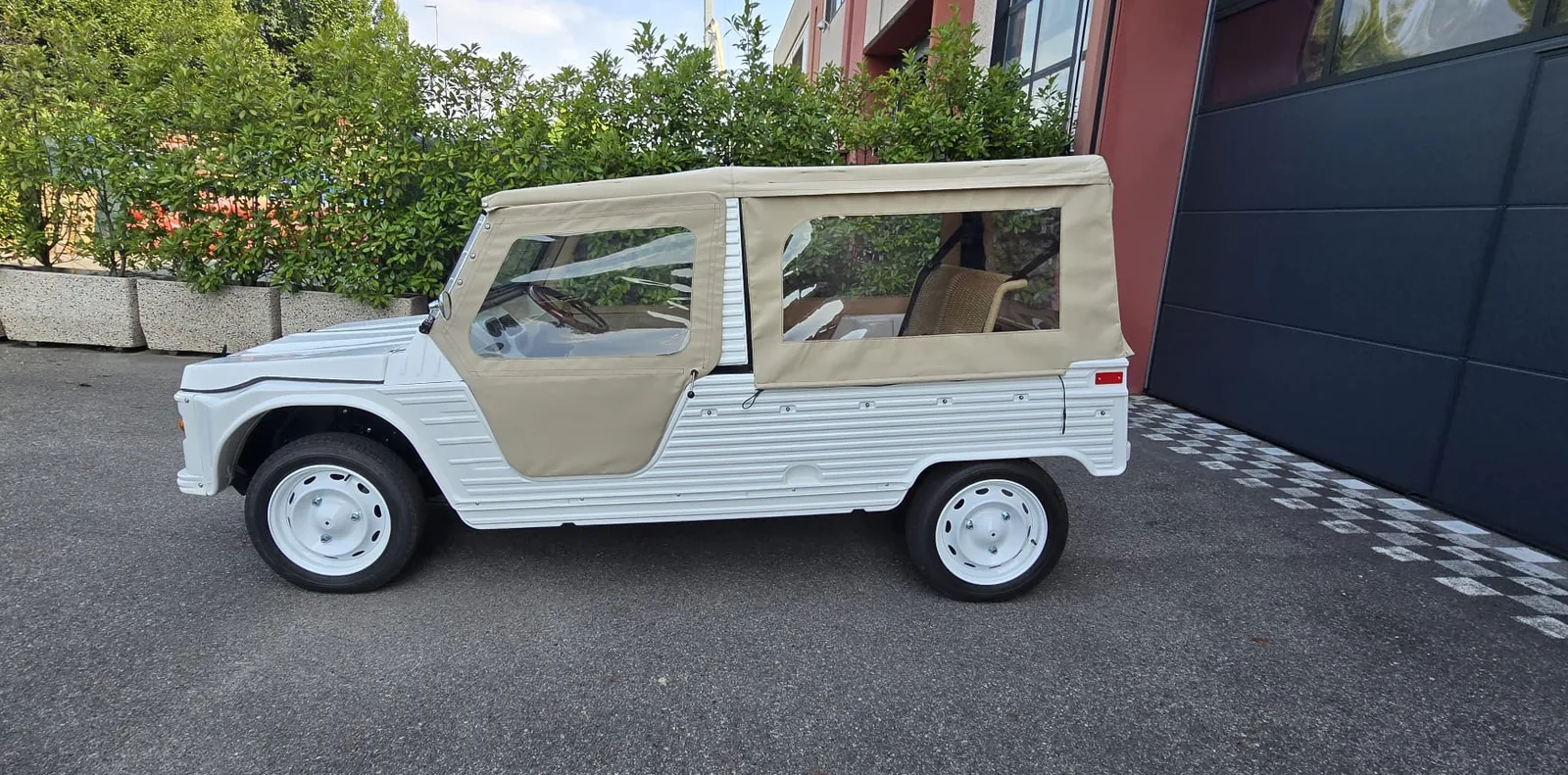
The Méhari was built without sides. There is no window between you and the Appian Way: the pines go past beside you, not beyond a pane. It is why the photographs come out different — and if part of why you are doing this is the photographs, that is not a detail.
Silence, which in Rome counts for something
The 500's twin-cylinder is part of the charm: you hear it, it vibrates, it tells you things. For an hour it is wonderful.
For eight hours, on Roman paving stones, with somebody next to you that you would like to talk to, it is noise. Electric on the Appian Way, you hear birds and tyres on stone, and you talk without raising your voice.
Where this car comes from
The Méhari was never conceived as a curiosity. It appeared in 1968 and became the car of Italian and French summers: elegant without being solemn, sporting in the way light things are, made for the country because a gravel road does not frighten it, made for the sea because it was the car of Saint-Tropez, Porto Rotondo and Capri.
It was the car kept at the beach house: out in the morning to fetch the bread, out again in the evening for dinner, dressed exactly as you were.
Which is why we do not put it in a line behind a guide. Most experiences of this kind in Rome either seat a driver in front of you or run you in convoy, and where the wheel is genuinely yours it is often on request, with a manual gearbox written into the requirements.
We hand you the keys and the roadbook. A car with a character only shows it when you choose the road.
Where the 500 wins, and we are not pretending otherwise
It is the 500. It is the most recognisable Italian car in the world, and if that specific car is the dream, no argument about seats and gearboxes will take it away from you. Quite right too: dreams are not there to be optimised.
It fits anywhere. It is short, it slips into gaps and parks in places where we have to go looking.
It has the sound. If what you want is mechanics, the smell, the movement of a gear lever, electric does not give you that and does not pretend to.
It is easy to find. There are plenty of 500s for hire in Rome, and at a lower price than ours. We are four cars: on spring weekends they go, and if you want to leave tomorrow you will find a 500 — ours has to be booked ahead.
Choosing, in thirty seconds
Take the 500 if there are two of you, if you can work a manual gearbox, if the drive is a couple of hours, and if that is the car you came here to drive.
Take the Méhari if there are three or four of you, if one of you cannot drive a manual, if you are out all day, if you have luggage or children, or if you would rather be comfortable than be squeezed for the sake of the story.
What you actually drive with us
Ours is an eStory: the Méhari reimagined as an electric car. The shape is the one you recognise; underneath there is a battery. Four seats, automatic, open sides, hand-woven rope seats, a nautical teak floor and a wooden steering wheel.
It is not fast, and that is exactly the point: the Appian Way and the roads through the hills were made for going slowly.
Ours are called Gina and Sophia, and you can tell us which one you would like when you book.
Practical answers
Do I need a special licence for the electric Méhari?
No. It is type-approved as a heavy quadricycle (category L7e) and you drive it on an ordinary category B licence held for at least a year: behind the wheel it feels exactly like an automatic car. Visitors with a non-EU licence also need an International Driving Permit. It is not allowed on motorways, which our routes never use — and in exchange quadricycles may enter Rome's historic centre restricted zone, where petrol vintage cars cannot go.
How many people really fit?
Four adults, seated comfortably, with room behind for rucksacks and a hamper. In a vintage Fiat 500 the rear seats suit children or short journeys.
Is it hard to drive?
No, and that is the point: no clutch, no gears. If you have driven an automatic, you can drive this. It handles like a city car and it is not fast.
What if it rains?
You still go. The full nautical-canvas enclosure, with windows and soft doors, keeps the cabin dry. If the weather turns genuinely bad we move your date or refund you.
How does the price compare with a Fiat 500 tour?
You pay for the car, not for a ticket each: €250 for two on the half day, €390 for two on the full day, plus €75 for the third and for the fourth seat. Four of you on a full day works out at €100 each, driving included and nobody else on board.