Rome ZTL explained: how to drive in Rome without getting fined
The fine that arrives eight months later
Thousands of visitors drive into central Rome every year without realising they have crossed a line. There is no barrier and no officer waving you down — only a camera on a pole. The fine reaches your home address months later, forwarded by the rental company with an administrative fee on top, and by then nobody remembers which street it was.
This is the single most common way a trip to Italy costs more than planned. It is also completely avoidable once you understand what the zones actually are.
What a ZTL is
Zona a Traffico Limitato means limited traffic zone: an area where only authorised vehicles may enter during certain hours. Residents, taxis, delivery vehicles and registered hotel guests are allowed in. Everyone else is photographed.
Rome has several, and they matter to a visitor in different ways.
The historic centre ZTL covers the area around the Pantheon, Piazza Navona, the Trevi Fountain and Campo de' Fiori. It is active on weekdays during the day and again on weekend evenings, with different hours in different sub-zones.
Trastevere and the San Lorenzo and Testaccio nightlife zones switch on in the evening, precisely when a visitor is most likely to be driving to dinner.
The Fascia Verde, the green belt, is different in nature: it is not about who you are but what you drive, and it excludes older, more polluting vehicles from a very large part of the city. Electric vehicles are unaffected.
Why rental cars make it worse
You will not be stopped, so you will not know. The camera reads the plate; the plate belongs to the rental company; the rental company identifies you to the authorities and charges you an administrative fee for doing so. The fine itself follows separately.
Cross three cameras in one afternoon and you receive three fines, each with its own fee. This is not unusual — the zones are contiguous, and a driver who enters one and turns around often exits through a different gate.
Who actually gets into the historic centre
There is one door that stays open, and almost nobody knows about it: quadricycles. In Rome's own regulations, motorcycles, mopeds and quadricycles are listed among the vehicles admitted into the Historic Centre restricted zone, without the paid permit that electric cars now need.
It is not a loophole. It is a deliberate choice by the people who wrote the rules: a quadricycle is short, narrow and light, it takes up half the room of a car, and in the old lanes it does not create the jam a normal vehicle creates.
Our eStory is type-approved as a heavy quadricycle, category L7e, and it is fully electric. Which means it goes where a petrol vintage Fiat 500 cannot go today and will not go tomorrow: that car is stopped twice over, once by the low-emission zone and once by the restricted zone.
Two details that will save you a fine. The A1 Tridente zone — between the Spanish Steps and Via del Corso — requires the number plate to have been registered with the city in advance, and ours are. And L7e type approval means no motorways or dual carriageways, which our routes never need.
Parking, which in Rome is half the problem
Getting in is one thing; stopping is another. In central Rome a free space, when there is one, is almost always a blue-line bay — and those are paid by the hour.
Electric vehicles park free of charge in the paid bays, once the number plate has been registered with the city. One thing confuses everybody, so it is worth saying plainly: since 30 June 2026 that registration no longer covers ZTL access, which became a separate paid matter. It now applies to parking alone.
Put together, the two change the shape of a day: you go in where others cannot, and you stop without hunting for a ticket machine.
How to stay out of trouble
Do not drive into the historic centre. There is nothing there you cannot reach faster on foot, and nowhere legal to park when you arrive.
Do not trust your phone's navigation. Route guidance will send you through a ZTL without warning unless you have explicitly told it to avoid restricted zones, and even then it is not reliable.
If your hotel is inside a zone, give the reception your plate number before you drive in. They register it with the city. Ask them to confirm it is done — a promise at the desk is not a registration.
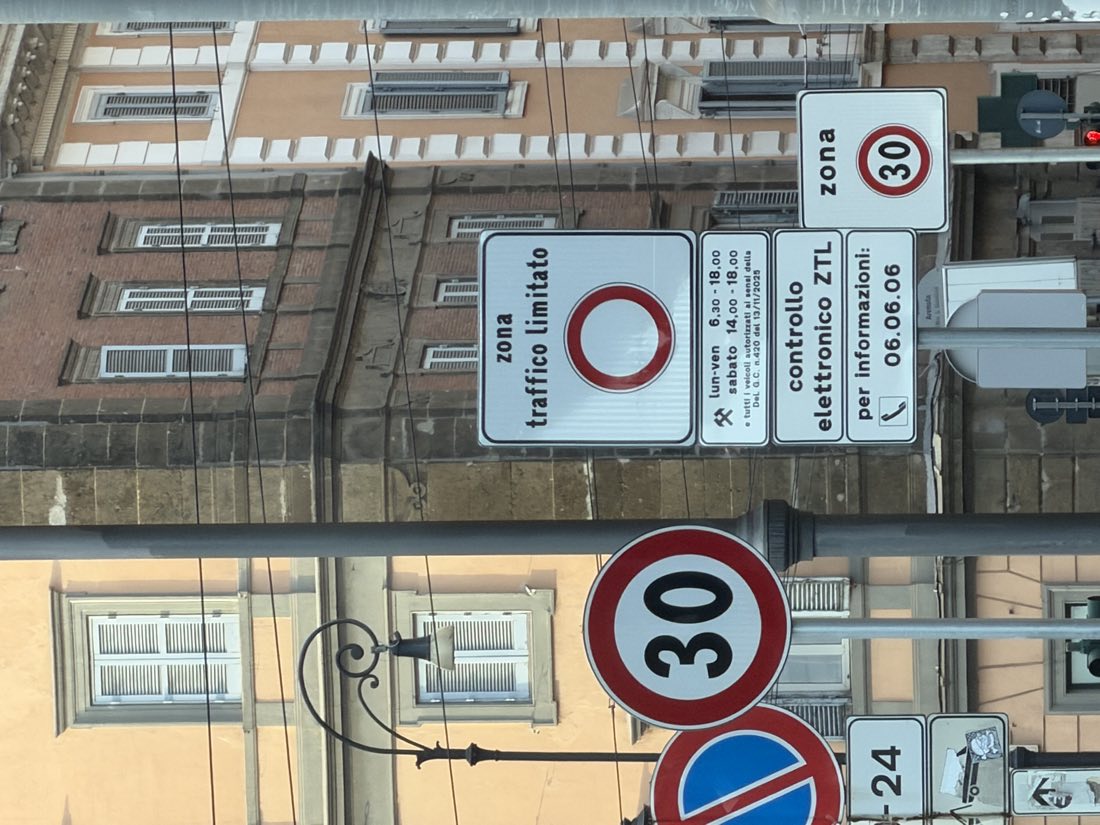
Watch for the sign: a white circle with a red border, with Zona a Traffico Limitato and the active hours below it. The camera is usually mounted just past it. If you see the sign and you are not registered, do not proceed.
Check the hours before you assume. Many zones are open at lunchtime and closed again in the afternoon. The sign tells you; guessing does not.
The simpler answer
The reason to have a car in Rome is not Rome. It is everything within an hour of it: the Appian Way, the hills of the Castelli Romani, the volcanic lakes, the wine towns. All of that lies outside every restricted zone, on roads where the only traffic is local.
Pick the car up outside the centre, drive out rather than in, and the entire problem disappears. You keep the freedom and you skip the cameras.
Practical answers
How much is a ZTL fine in Rome?
Typically around a hundred euros per entry, plus the rental company's administrative fee for identifying the driver. Multiple entries mean multiple fines.
How long does a ZTL fine take to arrive?
For a foreign address, months — often six to twelve. Notification deadlines are longer for drivers resident abroad.
Can I contest a ZTL fine from abroad?
You can, within the deadline stated on the notice, but the burden of proof is on you and the process is in Italian. Contesting is realistic only where the signage was genuinely absent or the vehicle was registered and the registration failed.
Are electric cars exempt from the ZTL in Rome?
Electric vehicles are exempt from the emissions-based restrictions of the Fascia Verde, but the historic-centre ZTL is about access authorisation, not emissions. Do not assume an electric car may enter — and since 1 July 2026 the permit that lets one in is paid, up to a thousand euro a year.
Is it hard to drive in Rome?
Inside the walls, yes — and rarely worth it. Outside, no: the roads towards the hills are ordinary provincial roads, and traffic thins out within twenty minutes of the ring road.