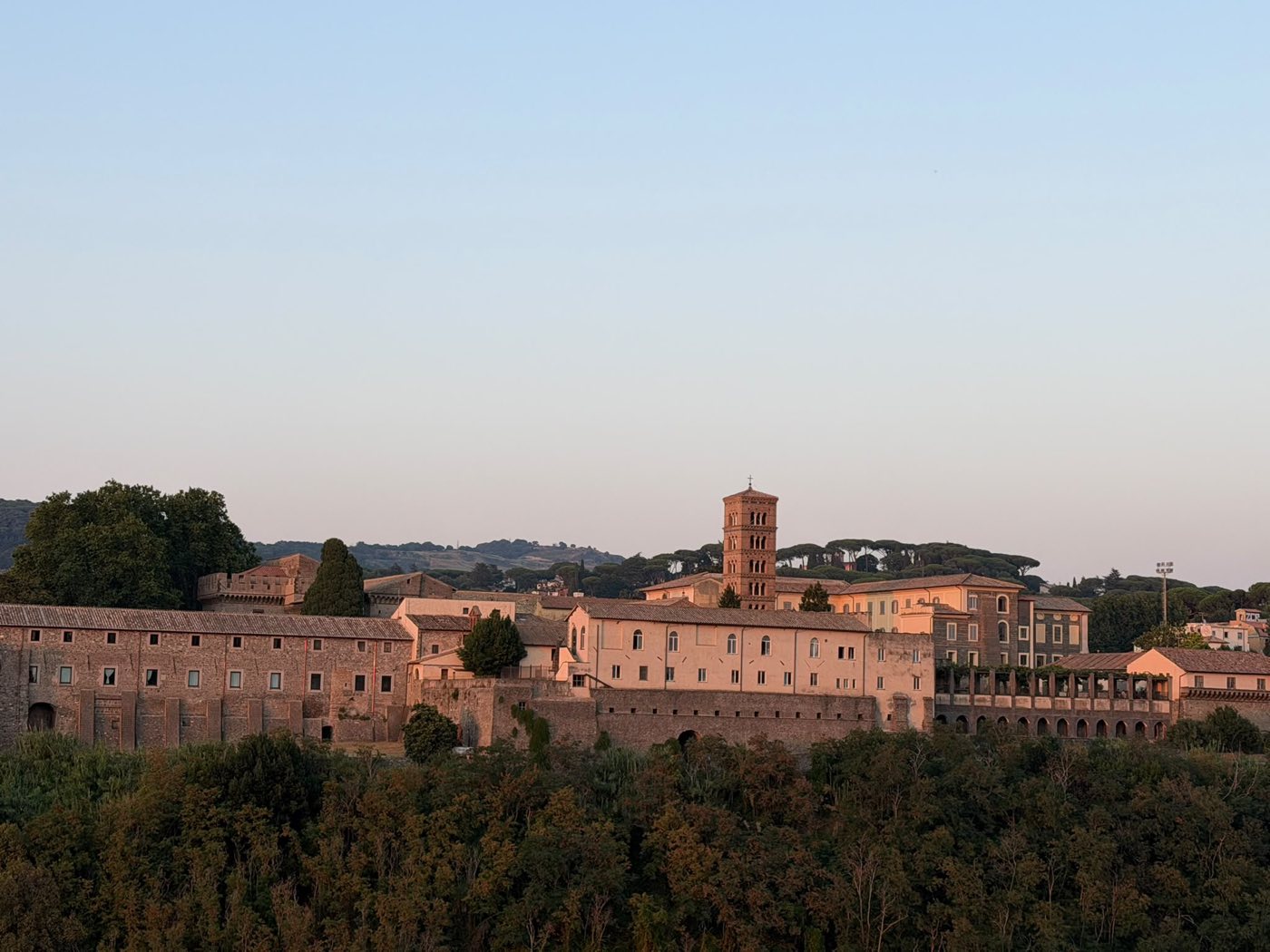
Grottaferrata: the Greek abbey outside Rome
A thousand years of Greek in the Latin hills
In 1004 an old monk from Calabria named Nilus, fleeing the Saracen raids that had emptied the Greek monasteries of the south, arrived on this slope below Tusculum and founded a house of Greek-rite monks. He died before it was finished. It has been working ever since.
That makes the Abbey of Santa Maria di Grottaferrata one of the oldest continuously inhabited monasteries in Europe, and the last survivor in the Rome area of a Byzantine Christianity that was once everywhere in Italy.
The monks are Catholic, in communion with Rome, but they celebrate in Greek according to the Byzantine rite. If you walk in during a service you will hear something that sounds like Athens and is happening twenty minutes from Frascati.
What you see
The fortress. In the fifteenth century Cardinal Giuliano della Rovere — later Pope Julius II, the one who fought wars and hired Michelangelo — turned the monastery into a military stronghold. What you approach is a moat, a drawbridge and bastioned walls, with a monastery inside them. Few religious buildings in Italy look this much like a castle.
The church. Behind an eleventh-century marble doorway and a Byzantine mosaic of the Deesis, the interior is small, dark and gold. The floor is Cosmatesque, the iconostasis is Greek, and the whole thing smells of incense in a way Latin churches do not.
The Farnese chapel holds the frescoes of Domenichino, painted in his twenties: the life of Saints Nilus and Bartholomew, in the clear Bolognese classicism that made his reputation. They are among the finest early-seventeenth-century frescoes anywhere near Rome, and almost nobody comes to see them.
The museum and the library. The abbey has been repairing books since the Middle Ages, and its manuscript restoration laboratory is one of the most respected in the world — the workshop where damaged codices from other libraries are sent. The small museum holds sculpture, icons and archaeological material from the site.
The town around it
Grottaferrata itself is a comfortable, prosperous hill town that Romans move to rather than visit. That gives it something the tourist towns lack: restaurants that live off residents.
It sits between Frascati and the ridge road up to Tusculum, so it is easy to fold into a day — twenty minutes from one, fifteen from the other.
When to go
Mornings, when the abbey is open and the light comes through the east windows.
Not on the days it closes, which vary — check before you plan the day around it.
In March the town holds a large annual fair that has run for centuries and fills the streets for days. Excellent to be caught in, difficult to drive through.
Why it is worth the stop
Because it is the opposite of what you came to Italy expecting, and it is ten minutes off the road you were already driving. A Greek monastery inside a papal fortress, with a Domenichino behind a curtain and monks who have not moved out in a thousand years, is the kind of thing that ends up being the story you tell at home — not the fifth Baroque church of the week.
Practical answers
What is Grottaferrata Abbey?
A Byzantine-rite Catholic monastery founded in 1004 by Saint Nilus, fortified in the fifteenth century, and still inhabited by monks who celebrate in Greek.
Can you visit the abbey?
Yes. The church and museum are open to visitors, with hours that vary by season and day.
How far is Grottaferrata from Rome?
About 22 km southeast, roughly forty minutes by car. Twenty minutes from Frascati.
Is there anything else to see in Grottaferrata?
The town is pleasant rather than remarkable; the reason to come is the abbey, and the restaurants that serve the people who live there.
Can I hear the Greek liturgy?
Services follow the Byzantine rite in Greek. Times are posted at the abbey; visitors are welcome to attend respectfully.